
Category: Review Page 1 of 2

Immersion amid a Sea of Confusion: A Review of The Secret of Chimneypots

The Secret of Chimneypots is a short scenario written for the glorious Casting the Runes roleplaying game (itself a derivation of the GUMSHOE ruleset modified to replicate the Edwardian ghost stories of M R James). Produced as an exclusive reward during the game’s crowdfunding campaign in 2020, the scenario is a self-contained mystery that can be easily run in a few hours.

Written by Christian Jensen Romer and released by The Design Mechanism, this publication is 30 pages all up and can accommodate a party of any size (although the author recommends up to 5 Investigators). Similar in design and layout to the core Casting the Runes rulebook (see here for my thoughts on that book) it has a very evocative cover drawn by Júlio Rocha, and a liberal sprinkling of period photos and line art throughout (including a very nice piece illustrating the adventure ‘McGuffin’ and some decent maps).

The adventure itself is set in the winter of 1900 and revolves around the strange events arising from the death of one Lionel Sharp, the owner of the small country holding called Chimneypots House. Drawn into this mystery, the Investigators will soon discover that the hauntings at the house are far darker and menacing than any simple ghost of the manor’s previous proprietor.
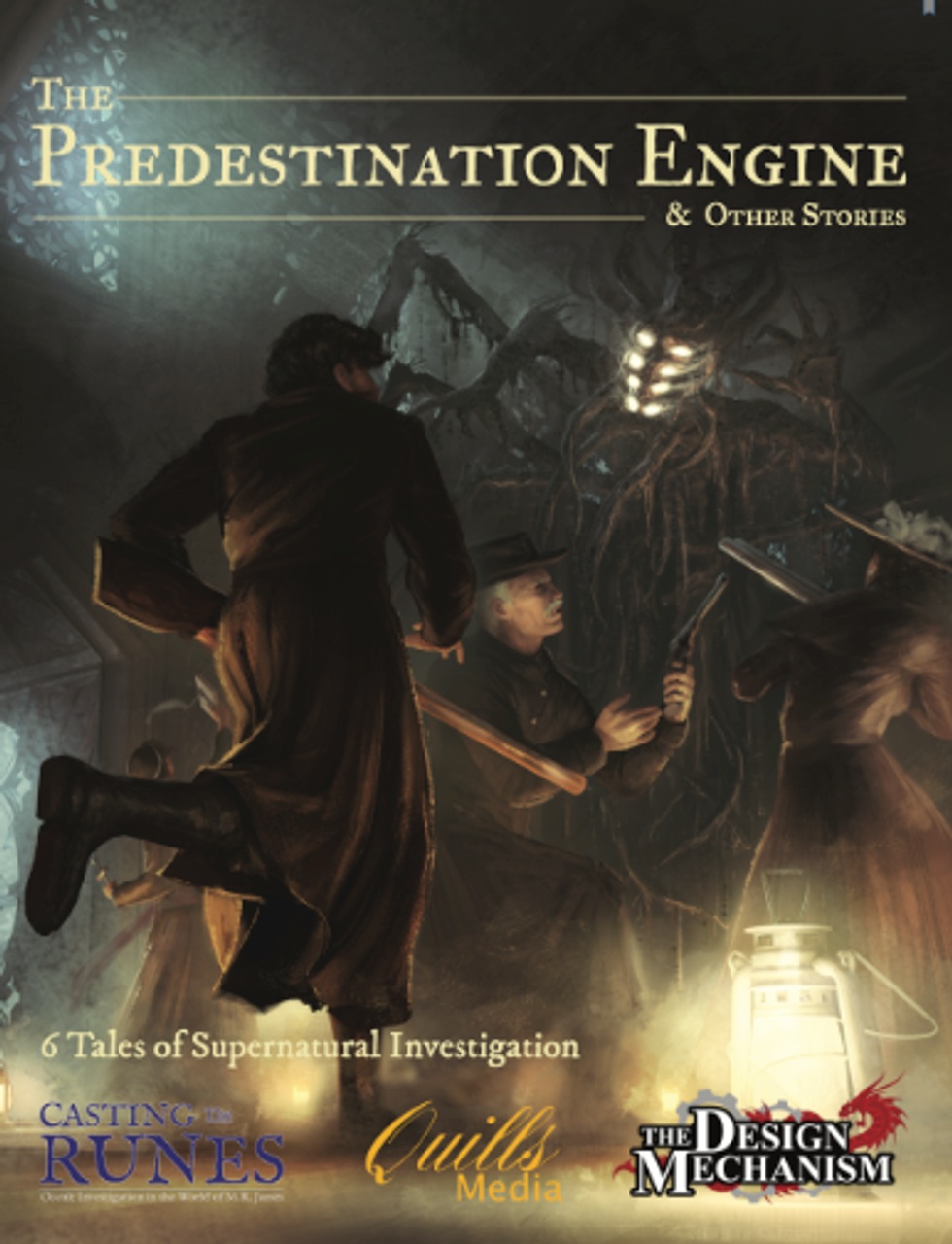
Quaint Mysteries & Curious Ghost Stories: A Review of The Predestination Engine & Other Stories

So dear reader, please allow me to indulge myself with a little story, one that harkens back to the airy days of late 2022, when half asleep and somewhat saddened by the prospect of travelling to work, your erstwhile reviewer was drawn once more into the world of quaint mysteries and curious ghost stories. We all know the story, an innocuous Facebook post, the lightest of clicks on a seemingly innocent link and the next thing you know you’ve suddenly added yet another book to your already overgrown RPG library… sigh…damn you DrivethruRPG!

Now, while, I know that little scenario was a little facetious, in this case at least, it does act as an appropriate lead into my experience of purchasing the wonderful The Predestination Engine & Other Stories; a collection of six scenarios by Paul StJohn Mackintosh and Tobias Cooper for Mr Mackintosh’s much respected Casting the Runes. That said, while my alter ego seems as if he was somewhat fooled or coerced into this purchase, I was overjoyed to delve once more into a new supplement for this fantastic roleplaying game.

For those of you who might not know of Casting the Runes, it is a game I’ve waxed lyrical about previously (see my review here). However, to save you time, let me reiterate my quick introduction with the following: Casting the Runes (or Casting the Runes: Occult Investigations in the World of M. R. James, to give its full name), is an impressive implementation of Pelgrane Press’ GUMSHOE open game system, set against the world of M R James’ unique late Victorian and Edwardian ghost stories. Of course, for some of you, the writings of Montague Rhodes James might not ring too many bells, but rest assured, if you’re a fan of horror, you will have most definitely felt his (indirect and direct) influence in everything from modern fiction, television, movies, and more. In fact, M R James’ stories are so much a part of the British ethos that even today his tales are still regularly being brought to life through a variety of media old and new.

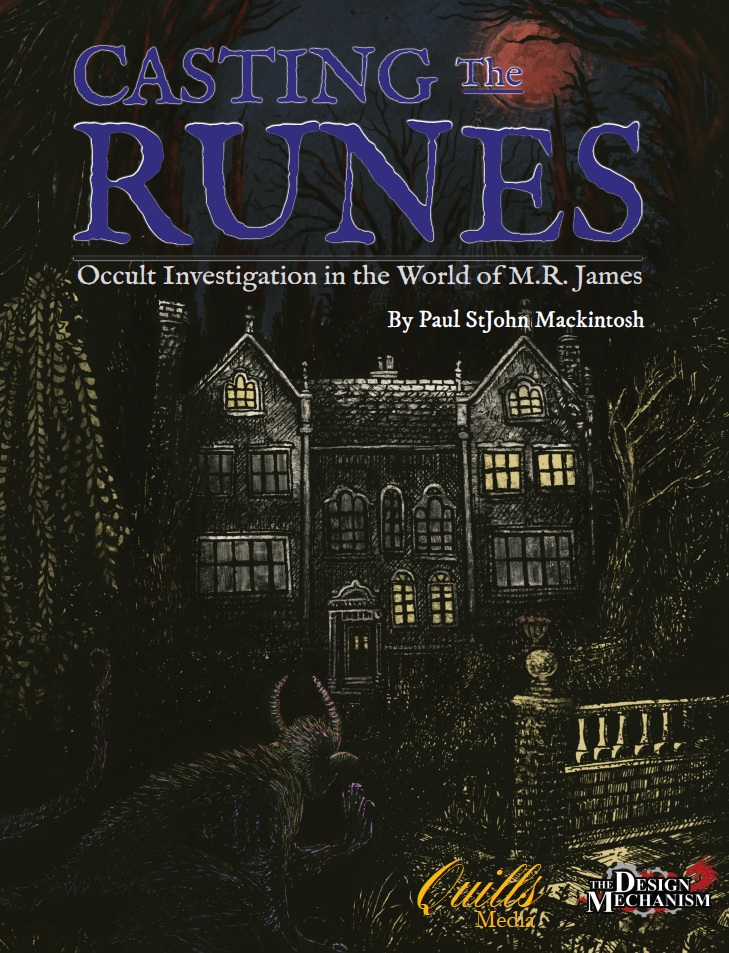
A Study in Quaint Horror: A Review of Casting the Runes

…It began, like all these stories do, with a brief message from a friend. This note was simple enough, and at the time one could little expect it to have as much an impact on my life and future as it would. So it was with little concern or trepidation that I clicked on the link provided in the aforementioned communique, expecting to find within it nothing more than a spark of light entertainment or, at worse, a selection of humour that one would find reluctant to share in one’s workplace. Imagine then, dear reader, my despair to discover that this link did not only lead me deep within the internet but would also reveal a dark and mischievous plot dedicated to parting your humble author from his hard-earned coin… yet another RPG Kickstarter!

Casting the Runes is a roleplaying game of Edwardian1 ghost stories and mysteries, written by Paul StJohn Macintosh, and published by The Design Mechanism. Based on the works of M R James, an English scholar and weird tale author of that period (whose style I have so ham-fistedly attempted to replicate above), it uses the GUMSHOE mechanics to reproduce investigative mysteries steepled in British graveyards, sprawling mansions, and occult practices.

For anyone who knows me, it will come as no surprise that this sort of setting and system are right in my wheelhouse, so much so that I’ve even attempted to do my own version of a gaslit GUMSHOE game once or twice in the past. The core book was funded via Kickstarter in early 2020, and I received my copy of the deluxe edition hardback a few weeks ago 2. Given the myriad of other Kickstarter games and items I’ve backed in the past, you have to be impressed by both the speed and quality of this crowdfunding campaign (although I believe at the time of this writing, the last of the North American backers are yet to get their copies – not long now, Covid impacts I believe!). I suppose I shouldn’t be too surprised at such a professional approach to the crowdfunding campaign, as the talent behind The Design Mechanism, Lawrence Whitaker, and Pete Nash, are top blokes, but in this day and age, even the most successful of publishers seem to be beset with delays and issues (only some of which, I reluctantly mention seem to be outside their influence).

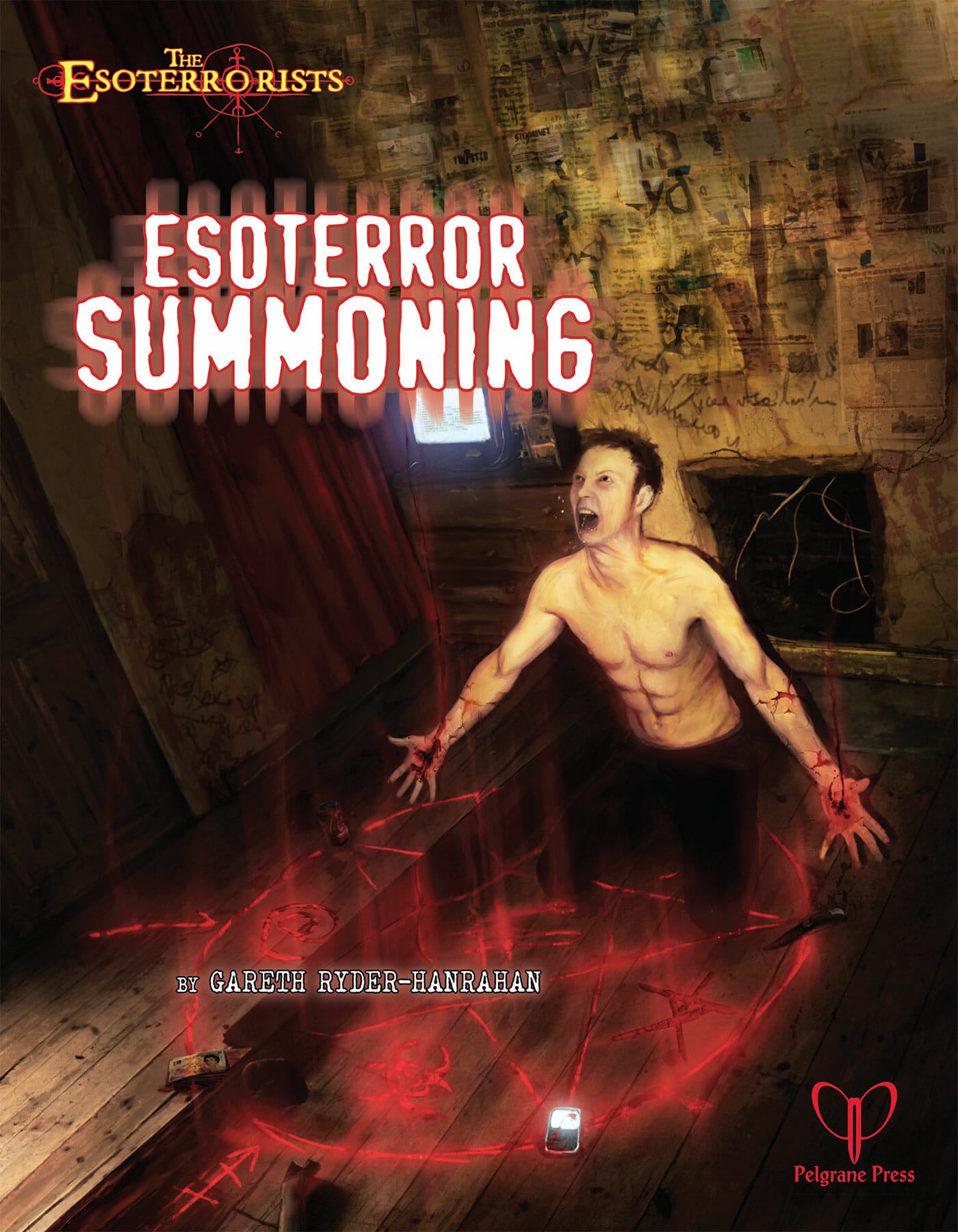
[Review] The Esoterror Summoning Guide

If I’ve ever publicly made a complaint about Pelgrane Press’ The Esoterrorists roleplaying game (powered as it is by the GUMSHOE system), then it has been the fact that no concerted effort has ever seemed to be made to really define its setting and background. As such, it often gets called a knock-off of other, more detailed, modern horror settings such as Delta Green, Hunter, or even good old Conspiracy X. (As an aside, I personally think this is an opinion that is a little unfair, given the unique approach The Esoterrorists takes on the conspiracy-horror genre, but hey!)

Despite this, it is still a valid point to say that if there is anywhere that Pelgrane Press has not done the game justice then it has been in its ongoing support. Sure, over the years we’ve had an expanded second edition of the game, a couple of official scenarios and even a campaign or two, but what has always been missing is that comprehensive explanation of the Esoterrorists world, i.e. the ‘this is The Esoterrorists bible’ or a guide that explains the game fictional premise in a concise manner. If that wasn’t unfortunate enough, what information there is about the ‘world of The Esoterrorists’ is spread between three separate products (these being the core rulebook, the excellent Esoterror Fact Book, and the supplement to which this review is dedicated – The Esoterror Summoning Guide)1.

So, why do I call The Esoterror Summoning Guide a vital part of the Esoterrorists’ core, and just what does this supplement add to the game? Well, read on and let’s see what’s inside this short but intriguing supplement, one that I think should be in everyone’s The Esoterrorists collection.

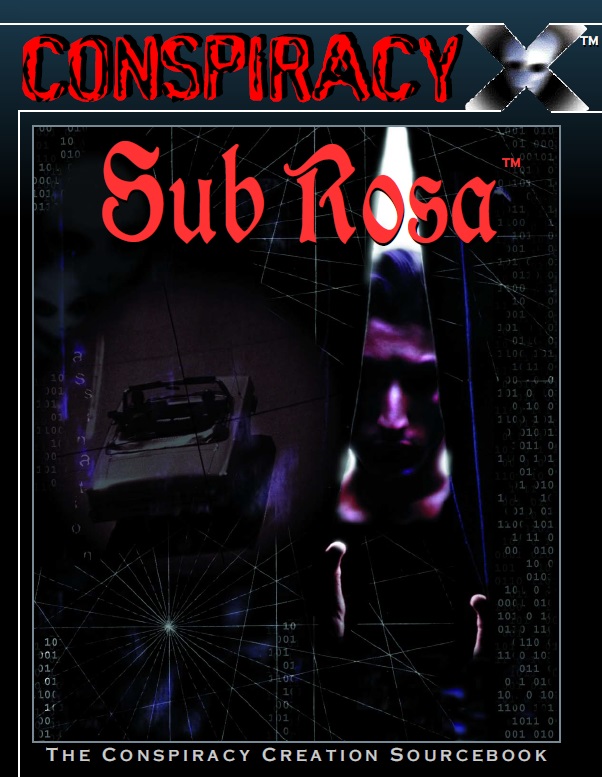
[Review] Sub Rosa – 1st Edition

“Three may keep a secret… if two of them are dead.”
– Benjamin Franklin,
Poor Richard’s Almanack

While Conspiracy X is best known for its setting focused on humanity’s ongoing struggle against aliens, monsters, and the supernatural, perhaps its most intriguing notion – its diamond hidden in the rough, so to speak – is its exploration into the very concept of ‘conspiracy’ itself. Sub Rosa: The Conspiracy Creation Sourcebook, is the game’s deep dive into this very subject, a supplement that aims to present a theoretical examination of how conspiracies come about, how they are run, and most importantly how they are created within the Conspiracy X ruleset.

But just how well does it succeed in this task? Do we get nothing more than a shallow look at the same old tired conspiracies we see in so many other game lines, or will it break the shackles and truly deliver a sourcebook that allows Game Masters to build brand new layers of intrigue into their existing campaigns? Well, dear reader, read on and we shall find out…

[Review] The Hand Unseen – 1st Edition

Let me tell you again, AEGIS nothing more than a cult and we, I’m afraid to say, have been lied to for far too long…

From its release in early 1996, Conspiracy X had always operated under one simple premise – the player’s characters, as members of a secret conspiracy known as AEGIS – are humanity’s last hope, the final protectors of mankind… the so-called ‘bodyguard of lies’. This book, The Hand Unseen, whips away that veil of half-truths and rumours and simply asks – What if AEGIS aren’t the ‘good guys’ we all believed them to be? What if their approach to the existential threat of extraterrestrial invasion and the rise of supernatural dangerous phenomenon as nothing more than closed-eyed, fear mongering? And if that is all true, then who will stand as the champions all of humanity?

That, my dear reader, is why this book exists, to tell you that there is another way, and that a programme for humanity’s salvation is already underway… whether you like it or not!

[Review] The Esoterror Factbook

Please note that this review was originally posted over on RPGGeek and is mirrored here for completist reasons only!

You know that feeling, the one that goes… “hang on now, they’ve definitely set this all up for a sequel, right?”. Well, that’s what I always felt when reading the original The Esoterrorists roleplaying game (the core rulebook now known as 1st Edition). Written by Robin D. Laws and published by Pelgrane Press in 2006, here you had gem of a great set of mechanics (the vast majority of what we know today as the GUMSHOE system), but no real substance behind it. I mean in The Esoterrorists 1st Edition you got the bare bones of anything you might realistically call a ‘game setting’, and worse, it really felt like a ‘quickie’ knock off of other more intriguing modern horror settings such as Delta Green, Hunter or even Conspiracy X. Sure, one could see that somewhere in the text there was a really neat unique game world just waiting to let loose … but where, oh where, was it!

Well, you’ll be pleased to know, 2009’s The Esoterror Factbook (also by Robin D Laws) is that missing ingredient; the background, context and detail that finally brings The Esoterrorists into its own… just a shame so few people know it even exists….

[Review] The Book of Unremitting Horror: Gumshoe Edition

Please note that this review was originally posted over on RPGGeek almost a decade ago (OMG!) and is mirrored here for completist reasons only!

If there is one genre that draws me more than any other in gaming, then it is horror. From the investigative paradigm of Call of Cthulhu, through the brutality of Kult, and even into the wackiness of Deadlands, the horror genre has always been more than just monsters hiding in the darkness to me. This generic interest in horror was probably what first drew me to The Book of Unremitting Horror, but it is its note-worthy content (which is much more than your typical collection of ghouls and goblins) that inspired me to write this review.

Page 1 of 2

Powered by WordPress & Theme by Anders Norén